

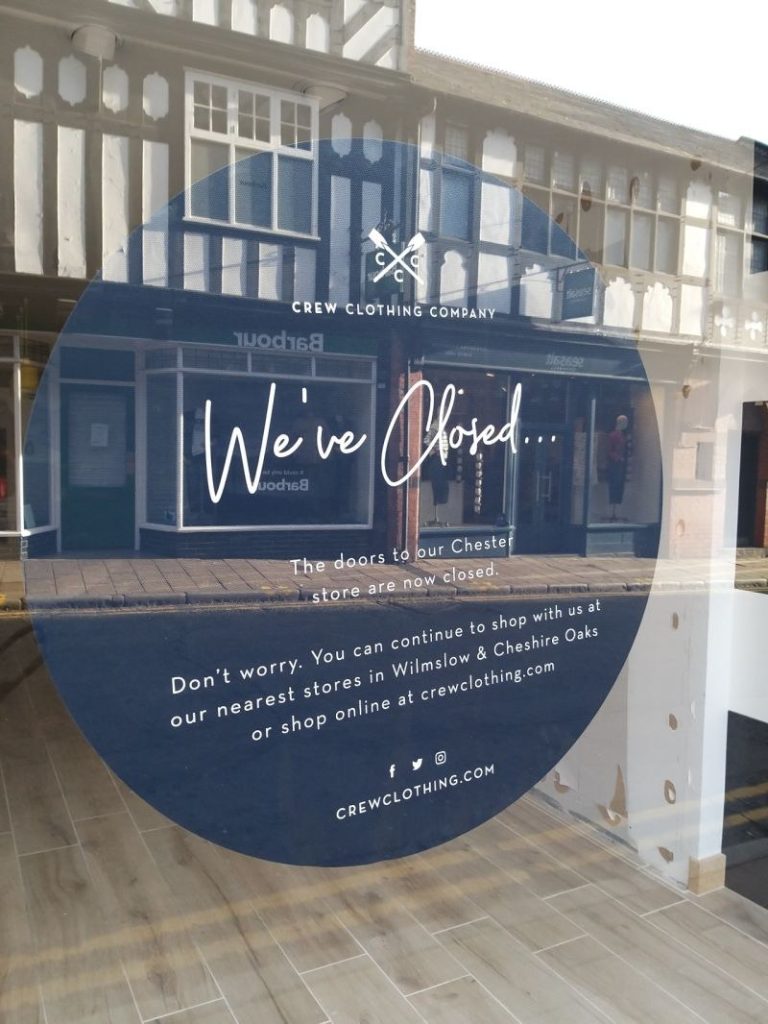
I walked through Chester city centre last winter and lost count of the shuttered shop fronts. The Crew Clothing store I had photographed only weeks earlier was already taped over with a “We’ve Closed” sign, pointing customers to Cheshire Oaks. A few doors down, Moss had a smaller version of the same announcement on its window: “This store will be closing on 15 January.” Two real brands, two real towns, the same story.
The reflex for most retailers in that situation is to direct foot traffic to the nearest open store and hope online picks up the slack. That is leaving money on the pavement. The right answer is to build a Google Shopping campaign with geo-targeted remarketing that replaces the closed store as a sales channel, not as a forwarding address.
From Closed Shop Front → Always-On Online Channel
Why a Closing Store Is Better Replaced Than Redirected
When a store closes on a UK high street, three things happen at once. The lease ends, the staff leaves, and the local search demand for that brand keeps going. The first two are visible. The third is invisible and is where most retailers lose ground.
People in Chester who used to walk past Crew Clothing every Saturday do not stop wanting Crew Clothing the day the store closes. They search for it. They look for the next nearest store, see Cheshire Oaks listed, and either drive there or, more often, click the next paid result on the search page. If the brand is not bidding on those local searches, the answer for that customer is whoever is.
The retailer in this scenario already has the catchment data. They know which postcodes the closing store served. They know the customer file. They know the local product mix. Every one of those inputs is a marketing asset that travels online when the physical store does not.
The Four Moves I Would Make on Day One
If a UK retailer told me on a Monday that they were closing a store at the end of the month, this is the playbook I would put in front of them by Friday.
Build a Google Shopping campaign with geo-targeting set to the closed store’s catchment. Use the same postcodes the store reported on, plus a 10–15 mile buffer for travel-distance customers. Bid more aggressively in those postcodes than in the rest of the country. The goal is to keep that local demand inside the brand instead of leaking it to competitors who are happy to pay for it.
Import the CRM into Google Ads as a Customer Match audience and run brand-awareness across YouTube, Discovery, and Performance Max. The customer file is the single most undervalued asset in this situation. Those people knew the store, walked into it, paid full price. They are the easiest first online conversion the brand will have.
Layer in dynamic remarketing across Meta and Google. Anyone in the closed-store catchment who lands on the website should see the products they viewed across every social and display channel for the next 30 days. This is the bit most retailers skip because it feels redundant. It is not. It is what closes the gap between “I clicked the ad” and “I bought.”
Move the budget that the physical store used to consume into content production and distribution. Rent, staff, and shop fit-out for a single store often run six figures a year. A fraction of that, redirected into product photography, video, and consistent paid placement, will outperform the closed store’s revenue for most mid-market UK retailers within a year.
Free Returns Is the Detail That Closes the Loop
The reason the closing customer hesitates online is fit. They could try the trousers on in the Chester store. They cannot try them on through a Google Shopping ad. The brand that wins is the one that removes the last reason to wait for a future store visit, and free returns is the cleanest way to do that.
I am not arguing that free returns is right for every brand or every margin profile. I am arguing that on the day a high-street store closes, the cost of a few returns is small compared to the cost of letting that local demand go cold. Paid for the right window, free returns reads to the customer as continuity of the experience they used to get in person.
The Mistake Most Retailers Make Instead
What I see most retailers do when a store closes is print a “we have moved online, visit our website” sign on the window and consider the digital part handled. The website was already there before the store closed. It is not the answer. The answer is paid distribution that targets the geography and the customer base the store used to own.
I would also push back on the instinct to redirect everything to the nearest open store. Cheshire Oaks is twenty minutes from central Chester on a good day. For a midweek office worker in Chester who used to nip into Crew Clothing on a lunch break, twenty minutes is the difference between a sale and a competitor’s sale. Online removes that distance entirely if the targeting is set up properly.
What This Looks Like a Year Later
The retailers I have worked with who treated a store closure as a marketing opportunity rather than a real-estate problem ended up with a stronger ecommerce business than they had before. The closed store’s revenue did not vanish. It moved to a channel where the unit economics were better, the data was richer, and the customer base could grow well beyond the original catchment.
The retailers who treated the closure as a forwarding exercise lost most of that revenue inside six months and never recovered it.
If your business is staring down a store closure or a network rationalisation, the work to keep that revenue is not in the press release. It is in the campaigns you build before the doors close. If you want to talk through what that looks like for a UK retailer at your scale, come find me at the next Ecommerce Camp UK. There are plenty of operators in the room who have already lived through this and figured out which moves actually moved the number.