

Most founders with twenty years behind them are sitting on a graveyard of their own content. Talks nobody can find. LinkedIn posts that lived for a day. A website that grew one page at a time and was never read as a whole. I was no different. I had over 340 posts and pages on my site, 245 LinkedIn updates, and 46 recorded talks, and almost none of it was working for me after the week it went out.
So I had it fixed. The team at Local Service Spotlight built me a single structured knowledge base out of everything I have ever published, and now we use it to repurpose that back catalogue into new articles on this site. This is my account of what that is, why I did it, and what it changed. If you want the outside view of the same system, BlitzMetrics documented it in two pieces: a public map of what the knowledge base contains and the full build write-up.
Why a Pile of Good Content Is Not an Asset
Content that is scattered is content nobody can use, including me. I could not tell you, off the top of my head, everything I had said about hosting, or how many times I had explained the no-contract model, or which store migrations I had written up. If I could not find it, a search engine could not weigh it, and an AI assistant could not quote it. Twenty years of real operator experience was sitting there as noise instead of signal.
The problem was never the quality of the work. The problem was that it had never been gathered, structured, and read as one body. That is the difference between a hard drive full of files and an asset that compounds.
What the Team Actually Gathered
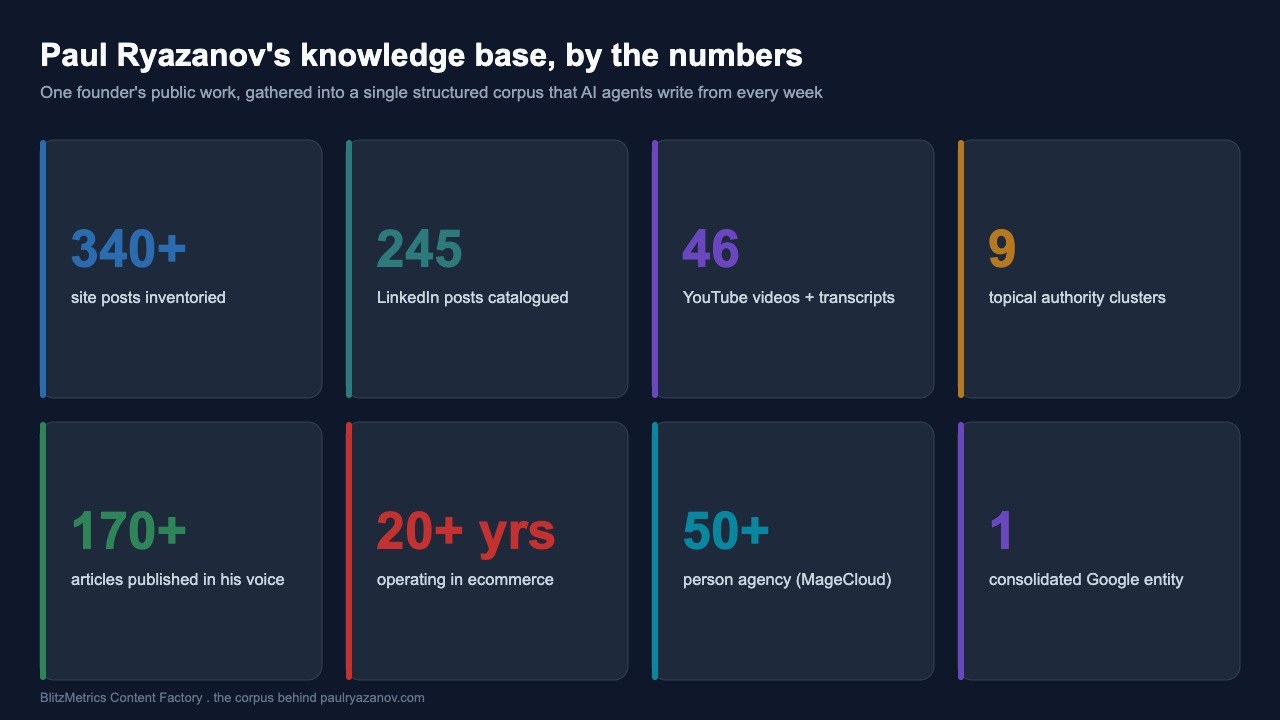
The first thing Local Service Spotlight did was pull everything into one place. My full website came down page by page and was inventoried. My LinkedIn archive was exported and catalogued down to 245 usable posts. Every one of my 46 recorded talks was transcribed so the words I said out loud became searchable text instead of being locked inside video.
What matters here is that nothing was invented. The system does not guess what I might say. It reads what I have actually said, in my own words, going back over a decade. When it writes, it is quoting a founder with a real track record, not filling in blanks.
MageCloud Knowledge Base Note
340+ site posts and pages inventoried
245 LinkedIn posts catalogued
46 recorded talks transcribed
9 clusters of expertise mapped
170+ new articles published in my voice
Paul Ryazanov · MageCloud · UK ecommerce founder, twenty years in
What My Nine Clusters Told Me About My Own Work
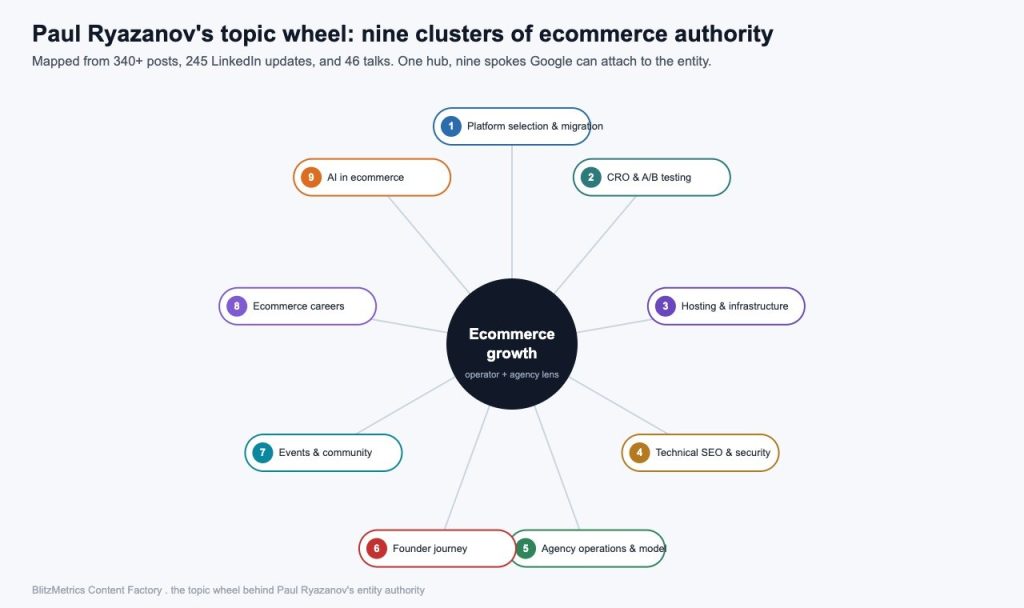
The part I did not expect was what the map showed me about myself. Read across the whole corpus and a shape appears. I do not write about everything. I write, consistently, about nine things, and those nine clusters are the real backbone of what I know.
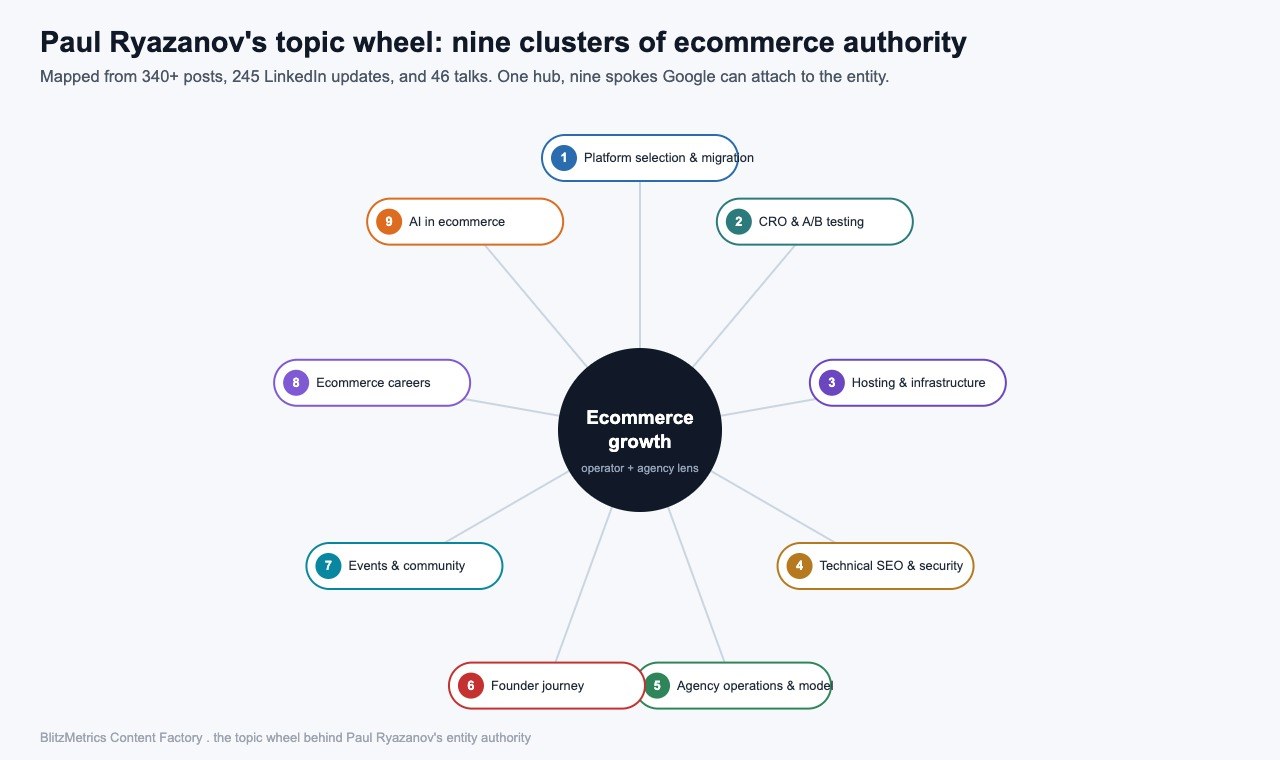
Two of them are the ones almost nobody else in my industry publishes. The way MageCloud runs, with no contracts, no retainers, and direct founder-to-founder communication, is a cluster I own because I am one of the few agency owners who works that way and explains it openly. Conversion and A/B testing is the other, and it runs back to a landing-page talk I gave in 2012. The rest of the wheel is just as concrete: platform migration, hosting and infrastructure, technical SEO and site security, the founder journey, ecommerce events, careers, and the newer question of AI in ecommerce.
A scattered founder looks like a generalist. A founder whose work is mapped looks like a specialist with nine named areas of depth. I have been the second one the whole time. I just could not see it until it was structured.
How One Old Post Becomes a New Article
The knowledge base is not an archive that sits still. We use it to repurpose my existing content. We take a post I wrote years ago, rewrite it into a full article in my voice, and publish it here under my name. Because the system has read every other post, it interlinks each new article to the rest of my library, which strengthens all of them at once. More than 170 articles have gone out this way.
Because the voice profile was built from my real transcripts and my shipped writing, the result reads like me. Sparing with contractions, no hype, evidence first, a founder talking to founders. When a draft drifts off my voice, a human on the team catches it. I am not handing my name to a chatbot. I am putting a decade of my own words back to work.
The Trade-Off I Will Admit To
I am not pretending this runs itself with nobody watching. It does not. The system is only as honest as the corpus it reads, so the corpus has to be kept clean, and the output has to be reviewed before it carries my name. What the system removes is the impossible part, which is a busy founder finding the time to mine twenty years of his own material by hand. What it does not remove is judgement. That still sits with me and the team.
Why I Bothered
I speak on more stages every year, I sign more partners, and more people look me up before they ever talk to me. When they do, I want them to find one consistent picture of who I am and what I know, not a stranger with the same name or a dead LinkedIn feed. A structured knowledge base is how you build that picture on purpose. Every article deepens a cluster, every cluster reinforces the same entity, and the whole thing points back to my site. For a founder, that is a pipeline, not a vanity project.
If you are running a business that has produced real work over many years and watching it disappear a week at a time, I would push you toward gathering it before you write another word. If you want to talk that through, or you want to meet other ecommerce founders working the same way, come find me at the next Ecommerce Camp UK. I will be the one not handing out brochures.