

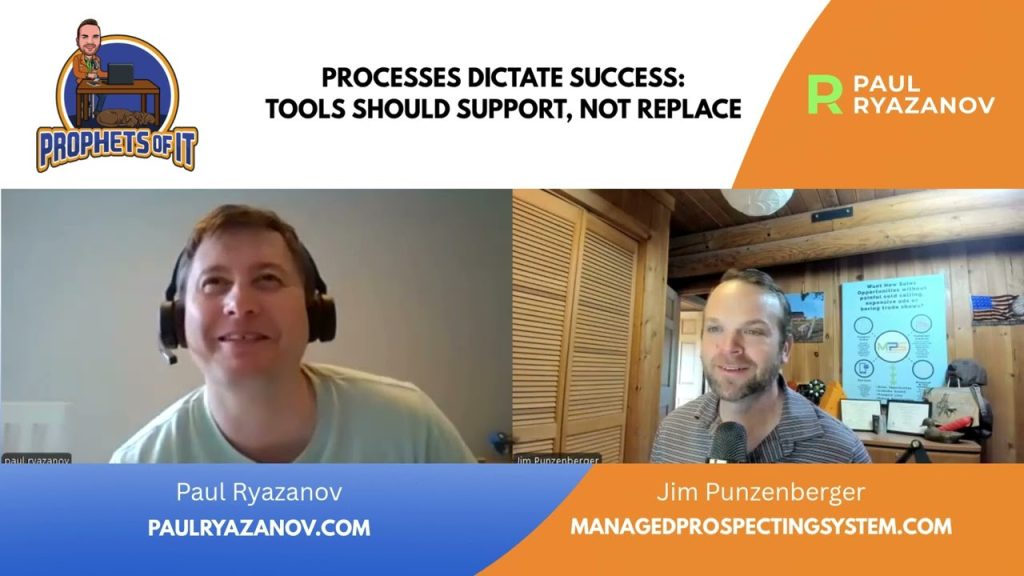
Most companies respond to an operational problem by buying another piece of software. I joined Jim Punzenberger on the Prophets of IT podcast to argue the opposite case: processes dictate success, not tools, and stacking platforms on top of a broken way of working just makes the mess run faster. The full conversation is above. Here is the argument, and where it came from.
Why I Do Not Believe the Tool Is the Answer
I have joined two companies in my career, one for eleven years and one for about two, and every single time I had to build the business processes almost from scratch. There were processes already, of course. They just were not the ones that decided whether the work was any good. Working with clients in the United States forced me to get specific about what actually matters and which numbers are worth watching.
That is where the view comes from. It is not a theory. It is what I kept finding under the bonnet of businesses that looked like they were running fine.
It is not the tool that is driving your business. It is the vision, the creativity, the opportunity to stand out as a company, rather than using platform A versus platform B. The processes are beating any automation. You can automate almost everything, but the processes within the company are the key to your success. The tool will not replace the people. Tools are just tools.
What We Actually Run at MageCloud
I am not anti-software. At MageCloud we run three or four different tools in the pipeline. The point is that none of them is the pipeline. They are connected to each other, and around them sit the parts that decide whether a client is happy: how content gets produced, how it gets delivered, and whether the quality is there when it lands.
Cold outreach on its own does not work any more, and no tool fixes that. A better sequence, a clearer definition of done, and a team that knows what good looks like will beat a bigger stack every time. If your process is wrong, automation just gets you to the wrong outcome sooner.
What Judo Taught Me About Business
I grew up in the Soviet Union in a very poor environment and I was hustling from day one, selling vegetables and whatever else there was. I trained judo from childhood. When computers and the internet arrived, I taught myself development and went from there. Jim asked how judo shows up in how I run a company, and the honest answer is that it taught me the same lesson twice.
In judo it is not necessarily about the age, and it is not necessarily about the weight. It is your experience that matters. Sometimes you win a fight when you should not be winning by any measurement. It is the same in business. You do not have to be the smartest person in the room. You do not have to have the best product in the market. You have to have consistency.
Talent alone is never enough. The founder who shows up with the same standard every week beats the more talented founder who is inconsistent, and it is not close. That is the whole game over a ten year horizon.
Where the Proof Shows Up
Two things in my business are the receipt for this argument. The first is that people stay. Employees at MageCloud have been with me for ten years and more, and nobody stays that long for a tool. They stay because the way we work is clear and because they are trusted to do it.
The second is a failure. We tried an expansion into Silicon Valley and it did not work. What broke was not the software and it was not the market. It was that we tried to scale an operation before the operation was ready to be scaled. That is the expensive version of the same lesson, and it is the one I would go back and teach myself.
The Question I Would Ask Before Buying Anything
Before you buy the next platform, ask what process it is supposed to support and whether that process exists. If you cannot describe it in plain words, the tool is not going to invent it for you. Buy the software after you have fixed how you operate, not instead of fixing it.
This is the same reason I run an agency with no contracts and no retainers. The work has to hold the relationship together, which means the process has to be good enough to hold the work together. It is also why I keep saying that ecommerce is a marathon, and why the founder stories I find most useful are the ones about staying in it, like Ben Fridja walking away from his Dragons’ Den deal. I have written about the operational side of running the agency itself in going from freelancer to CEO.
Podcast Appearance
Show: Prophets of IT, hosted by Jim Punzenberger
Topic: service quality, operational discipline, and why strong businesses are built on process, not software
Background: database engineer, born in the Soviet Union, judo from childhood
Team: colleagues who have stayed 10+ years
Hard lesson: a failed expansion into Silicon Valley
Paul Ryazanov · MageCloud · Founder, Ecommerce Camp UK
If your stack keeps growing and your delivery keeps slipping, the tool is not the problem. Come and argue with me about it at the next Ecommerce Camp, or watch the full conversation with Jim above.