

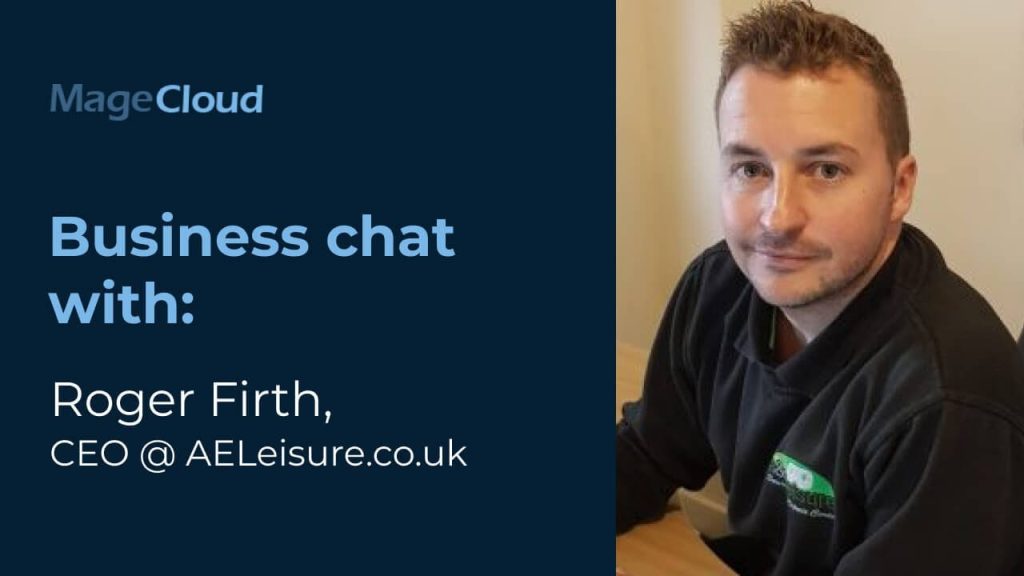
A&E Leisure is a caravan and motorhome business in the UK, and when I sat down with their CEO Roger Firth, he said something I have repeated to founders ever since. Three weeks into July, they had already matched their entire online turnover from the year before.
That is what scaling ecommerce actually looks like when the foundation is right. Not a lucky spike, but a platform that was finally built to absorb demand at the moment demand showed up. I wanted to record the conversation because Roger runs the kind of business most agencies never see up close: a real service operation with a workshop and a body shop, doing about two million a year, with ecommerce bolted on and, for a long time, held back.
From £30K on eBay to £150K in a single month
Roger started A&E Leisure in 2011 when the company he worked for went under. Three of them began as a service and repair shop for caravans and motorhomes, moved to a small retail unit, then a larger one. Around 2017 they tested ecommerce on eBay and did roughly £20,000 to £30,000 that year. eBay is expensive to sell on, so they pushed to move the turnover onto their own platform, growing online to about £60,000 to £70,000 a year, then just under £100,000.
Then they moved the build to us, right before the UK went into lockdown. Here is how Roger described the shift, in his own words:
“We spent a lot of money with that company, and we got a new website, but I felt we were always challenging them and asking them to do things for us rather than them showing us what could be done. When we went to you guys, that is when it really started to take off, if I am honest. So I credit you with that, Paul, to be fair.”
The numbers followed. When lockdown hit and shops closed, the online side carried the business.
“Last month I think we turned over about 150 grand online within the month. Three weeks into July we have done our entire online turnover of last year.”
The difference between a vendor and a partner
The line that matters in that quote is not the revenue. It is “asking them to do things for us rather than them showing us what could be done.” That is the exact gap between a vendor who waits for a ticket and a partner who brings the roadmap. A retainer that just bills every month while you do the thinking is not a growth partner. I have written before about why that relationship, not the platform logo, is what actually lasts. See how one project with A&E Leisure held together years later.
The channels that carried the growth
None of this was one clever tactic. Roger runs a shopping campaign for the ecommerce side and a smaller, deliberately low-spend campaign for the service business. He has four to five thousand people on an email database he mails when the business needs it, and a Facebook group where younger customers in the caravanning world chat, ask about products, and buy through a link when they are ready. His structure is unusual and it works: WordPress as the service front end, Magento as the store. If your store is doing the selling, the product page has to earn it, which is a point I make constantly. See why most stores have a conversion problem, not a traffic problem.
Roger’s rule: if it does not feel right, it is not right
I asked him about his biggest mistake in ten years of trading. His answer was not about tools or platforms. It was about people, and about trusting the signal when a relationship is hard work.
“If it does not feel right, it is not right. If it is hard work dealing with a member of staff, if it is hard work dealing with an outside contractor, then they are not right for you. If you have to do all the work for them, then it is no good. You either win or you learn.”
That is the same test I use when deciding who to work with, which is part of why I turn down projects my own company could profit from. The wrong-fit client costs more than the revenue is worth.
His message to founders
With three minutes left I asked what he would tell a young entrepreneur starting out online. He did not sell a dream.
“Social media gives people the idea that get rich quick is a real thing. It might be for a tiny percentage, but it is not true. Create a structure, methods and processes that are strong and that work as you scale. You cannot fly by the seat of your pants for too long. Learn, hone your craft, be a specialist in your field, and then go out and dominate it.”
And the line I keep: “The more you practice, the luckier you get.” Business, he said, is very little about luck and much more about applying layers of hard work until the turnover grows.
What I took from it
A&E Leisure did not need a bigger idea. They needed a platform that could keep up and a partner who would show them what was possible instead of waiting to be told. When both of those were in place, a year of online sales landed in three weeks. If you are running a real business with a real operation behind it and the ecommerce side keeps stalling, that is usually the gap to close first. Book a call and we will look at where yours is stuck.
Roger’s story is really about foundation. The store scaled because the platform was finally built to absorb demand, the same lesson as growth being about the foundation, not the next tactic, and it held because the right people stayed on it, which is why the partner matters more than the platform.