Agent 03 · Monthly · Conversion
The CRO Experiment Planner
I have been doing conversion optimization since before it had a conference track — heatmaps at PubCon, 300% lead-gen lifts through iterative testing at Conversion Conference. The discipline never changed: no redesigns on opinion, no tests without evidence. This agent compresses the planning weeks into a morning.
Get this skill — free in the packMageCloud CRO services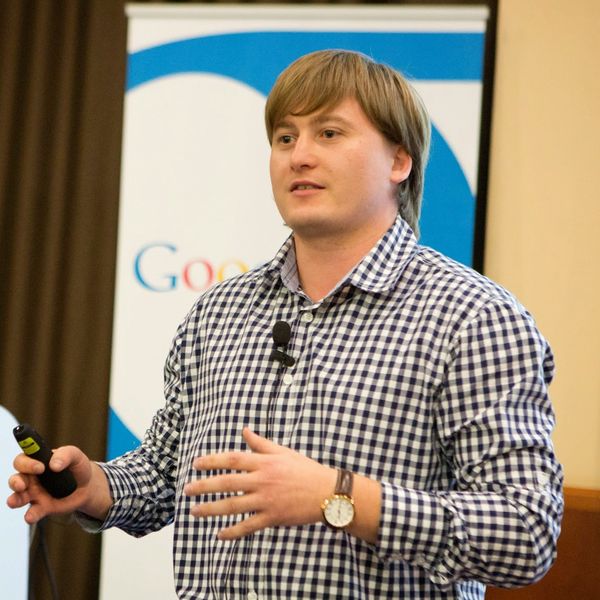
Paul Ryazanov presenting on stage for Google
What it takes off your team’s plate
Where CRO programs stall — and what this agent absorbs:
How a run works
From constraint to build-ready briefs:
- Locate the constraint. From the revenue aggregator’s decomposition: which template, which device, which funnel step. ‘Mobile product page → cart add-rate’ is a constraint; ‘improve conversions’ is rejected as too vague to test.
- Gather evidence per candidate. The constrained template gets walked against the heuristics that decide most e-commerce cases — price and delivery visibility, trust at the money moment, form friction, express wallets — and every candidate needs the Clarity behavioral signature confirming users actually hit it.
- Write real hypotheses. ‘Because we observed [evidence], we believe [change] will [effect]. We will know if [metric] moves by [minimum detectable effect].’ Every time.
- Score with honest ICE. Impact sized against revenue at stake, confidence graded by evidence strength, ease in real dev-hours respecting the platform — a Shopify section change is not a Magento checkout modification.
- Run the power math. Baseline CVR, minimum detectable effect, weekly eligible sessions → weeks to significance, shown on every candidate. Under-powered ideas get said out loud, not queued.
- Ship 3–5 build-ready briefs. Control versus variant element by element, targeting, primary metric plus guardrails, platform implementation notes, QA steps. If a developer needs a meeting, the brief is not done.
✋ The approval gate
Experimentation with adult supervision:
- No test proposed without behavioral evidence — heuristic-only ideas are labeled OPINION
- Sample-size math is mandatory and shown; no ‘we’ll see how it goes’
- One primary metric per test, declared before launch; guardrails watched, not harvested
- The optimizer approves the backlog order and owns the client conversation
What you get
CRO-BACKLOG-[client]-[month].md — every candidate scored, including the rejected ones
The Comerix conversion framework I use came out of two decades of this work — usability workshops for teams like ANS in Manchester, A/B methodology on stages from Las Vegas to Kiev. The agent does not replace that judgment; it makes sure judgment is what my team spends its time on.
I have written about this from the trenches:
Works together with
Run it yourself, or bring my team in
The skill is free in the pack — install it and start this week. If your store does seven figures and you want this running inside a full revenue-optimization engagement, my team at MageCloud handles it end to end.
