E-Commerce · Revenue Optimization · AI Agents
How My Agency Grows E-Commerce Revenue With AI Agents
My team keeps the strategy, the client relationships, and every final decision. AI agents do the mechanical work underneath — pulling Google Analytics, Google Ads, and Clarity into one truth, running audits, planning experiments, drafting reports. This page shows the exact system, and you can download it free.
Download the Agent Pack — FreeSee If We Should Work Together
Scan to open this page.
Seeing this on a conference screen? The QR brings you here — the full system and the free download.
One optimizer, a team of agents
This is the operating model. A human runs the engagement. Agents feed that human one reconciled version of the truth plus drafts and proposals — and nothing touches a live store or ad account without a named person approving that specific change.
Your Optimizer (human)
Owns what agents cannot:
- Strategy and positioning — why this store wins
- The client relationship and hard conversations
- Judgment calls on tests, budgets, and priorities
- Final approval on every proposed change
Revenue Data Aggregator
GA4, Google Ads, Clarity, and platform orders reconciled into one revenue view — decomposed into sessions × conversion × AOV.
Full details →OnboardingGrowth Audit
Six-pillar scored audit of the store — tracking, paid structure, feed, conversion path, measurement, authority.
Full details →MonthlyCRO Experiment Planner
Behavioral evidence → ICE-scored backlog → build-ready A/B test briefs with sample-size math.
Full details →TakeoverAds Account Audit
Google Ads deep-dive: wasted spend in currency, true brand vs non-brand ROAS, restructure map.
Full details →LaunchCampaign Builder
Plain-English brief in, launch-ready campaign out — every setting reasoned, held for approval.
Full details →WeeklyAds Optimization Loop
Search terms, negatives, pacing, disapprovals, anomalies — delivered as an approval queue.
Full details →MonthlyFeed QA
Merchant Center health: titles, identifiers, price mismatches, custom labels. The feed is the ad.
Full details →ReportingClient Report
Metrics → Analysis → Action, in plain English — the document a results-based engagement lives on.
Full details →AlwaysWork Documentation
Every engagement becomes sharper SOPs, case studies, and public proof — the compounding loop.
Full details →Why I am showing you the whole system
Most agencies hide their process and sell the mystery. I think that era is ending, and the agencies that survive will be the ones willing to show their machinery.
From billing hours to owning results
I built MageCloud as a development agency — dozens of engineers and marketers across the UK, Denmark, Ukraine, and the USA, shipping and maintaining stores for two decades of clients. That model bills hours. I am moving the agency to a harder standard: result-driven revenue optimization, where we get judged on what the store earns. That standard only works if every project runs on one reconciled version of the truth — Google Analytics, Google Ads, Clarity, and platform orders aggregated per client — and if the mechanical work never eats the thinking time. That is exactly what these agents do.
Built with Dennis Yu, proven in public
This pack adapts the agent system Dennis Yu runs in the open at BlitzMetrics — where the SOPs are published, agents execute from them, and every execution is documented back as a meta-article that improves the SOP. His team showed an agent building and launching a complete Google Ads campaign — every setting reasoned, for under a dollar of compute — and publishes every audit their agents produce. We tuned that system for e-commerce PPC together.
The results this system protects
Agents handle mechanics; these outcomes come from strategy, teams, and years of iteration. A sample from stores I have worked with — the full record is on my achievements page.
“It was a pound in and 50 pence out with every other agency I used before; when Paul got involved, we were putting 50p in and getting a pound out in round figures.”
“We found these guys to be blunt to the point, very good at what they do, and able to sort out any problem we had.”
“What I found compelling about MageCloud, compared to other agencies, was their ability to go the extra mile, their responsiveness, and their clear knowledge.”
More third-party record: my PubCon speaker bio, an on-camera interview with Search Engine Journal on user-behavior tracking, mentoring on GrowthMentor, and the community I founded, Ecommerce Camp. Talks and podcasts are listed on my speaker page; client reviews live on the reviews page. And I keep sharp company — practitioners like Igor Ivitskiy, the Google Ads scientist ranked among the world’s top PPC experts, are the kind of people this system gets pressure-tested against.
The human behind the system
AI pages are easy to generate and easy to distrust. So here is the part no model can fake: twenty years of stages, workshops, and client rooms. I built this system with my team at MageCloud and with revenue-share partners across the stack — from the Comerix conversion framework to payment processing — because optimization only counts when someone owns the result.
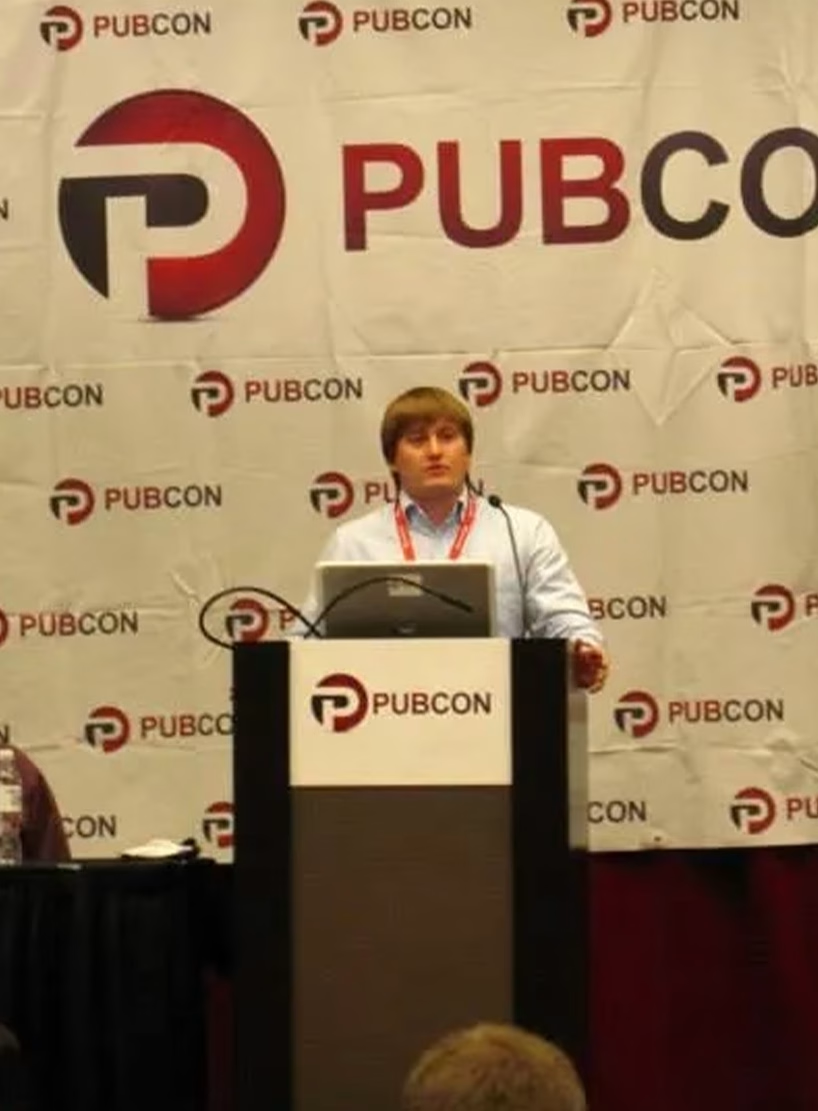
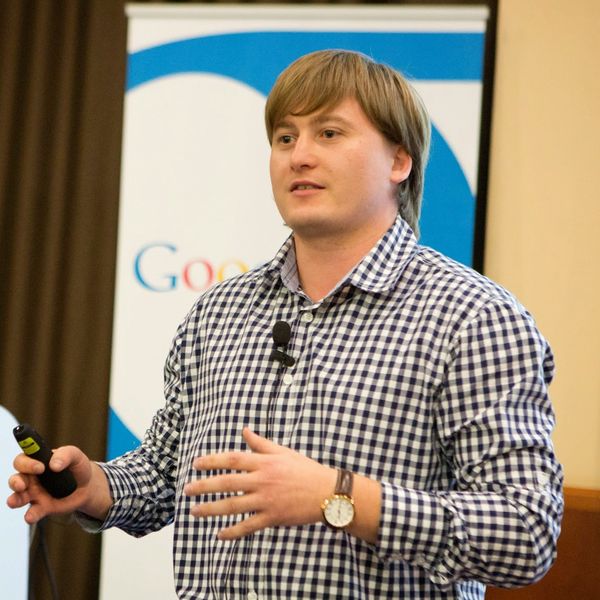


On camera with Search Engine Journal
Loren Baker interviewing me at PubCon on user-behavior tracking and conversion — the discipline this whole system automates. More talks and podcasts on my speaker page and YouTube channel.
New here? Start with who I am and the evidence record.
Download the Revenue Optimization Agent Pack
Nine agent skills plus the install guide. Free, no email wall — take it, run it, improve it.
- revenue-data-aggregator
- ecommerce-growth-audit
- cro-experiment-planner
- ppc-account-audit
- ppc-campaign-builder
- ppc-weekly-optimization
- merchant-feed-qa
- ecommerce-client-report
- agency-work-documentation
- README with ground rules
- Unzip. Each folder inside skills/ is one agent skill (a SKILL.md file).
- In Claude: Settings → Capabilities → Skills → add each skill. In Claude Code: copy folders into .claude/skills/.
- Ask: “Run the weekly revenue digest for [client].” The agent works; your team approves.
Take the pack, or bring us in
Both paths are legitimate. The honest split:
Run it yourself — free
- You have an in-house marketer or a hands-on founder
- You want the mechanical hours back this week
- You are comfortable approving changes from an evidence queue
- Download above, install, start with the weekly revenue digest
Work with my team
- Your store does seven figures and growth has flattened
- You want the 6-month plan — audit, strategy, execution, and team training
- You want agents installed inside your operation, with my account managers running them
- Start with a call: book here or via MageCloud
Questions I get about this
Will these agents replace my team?
No, and they are deliberately built not to. Every skill ends at an approval gate. The agents remove the report-pulling, reconciling, and checklist hours; your people keep the judgment, the strategy, and the client. Teams that use agents this way get faster and sharper — they do not get smaller.
What do I need to run the pack?
A Claude subscription (or any agent framework that reads Markdown instructions), read access to your GA4, Google Ads, Microsoft Clarity, and store platform, and a human who reviews the approval queue. The skills are plain Markdown — open them, read them, edit them.
Why give this away instead of selling it?
Because the SOPs are not the moat — the operators are. Publishing the system builds trust with the exact people I want to work with, and the ones who want it done for them hire the team that wrote it. Dennis Yu has run this playbook in public for years and it works.
Is it safe to let an agent touch a live ad account?
The pack defaults to read-only. Changes ship as proposals with evidence and risk notes, capped at ±15% on bids and 20% on budgets per week, and a human approves each line. Tracking problems halt the run entirely — no optimizing on corrupted data.
Is this only about ads?
No — ads are one lever of five. The pack optimizes revenue: the aggregator reconciles all channels against real orders, the CRO planner works on conversion rate and order value, and the reporting ties everything to money. The ad-channel skills cover Google Ads first because that is where deterministic waste is largest; the structure transfers to Meta, Microsoft, and Amazon.
Does this work on Magento?
Magento is where my team lives — MageCloud has shipped everything from multi-million-SKU migrations to 400,000-order-a-year stores. Catalog scale is exactly where mechanical agent discipline pays most, so there is a dedicated page on running these agents on Magento (Shopify and WooCommerce too).
