


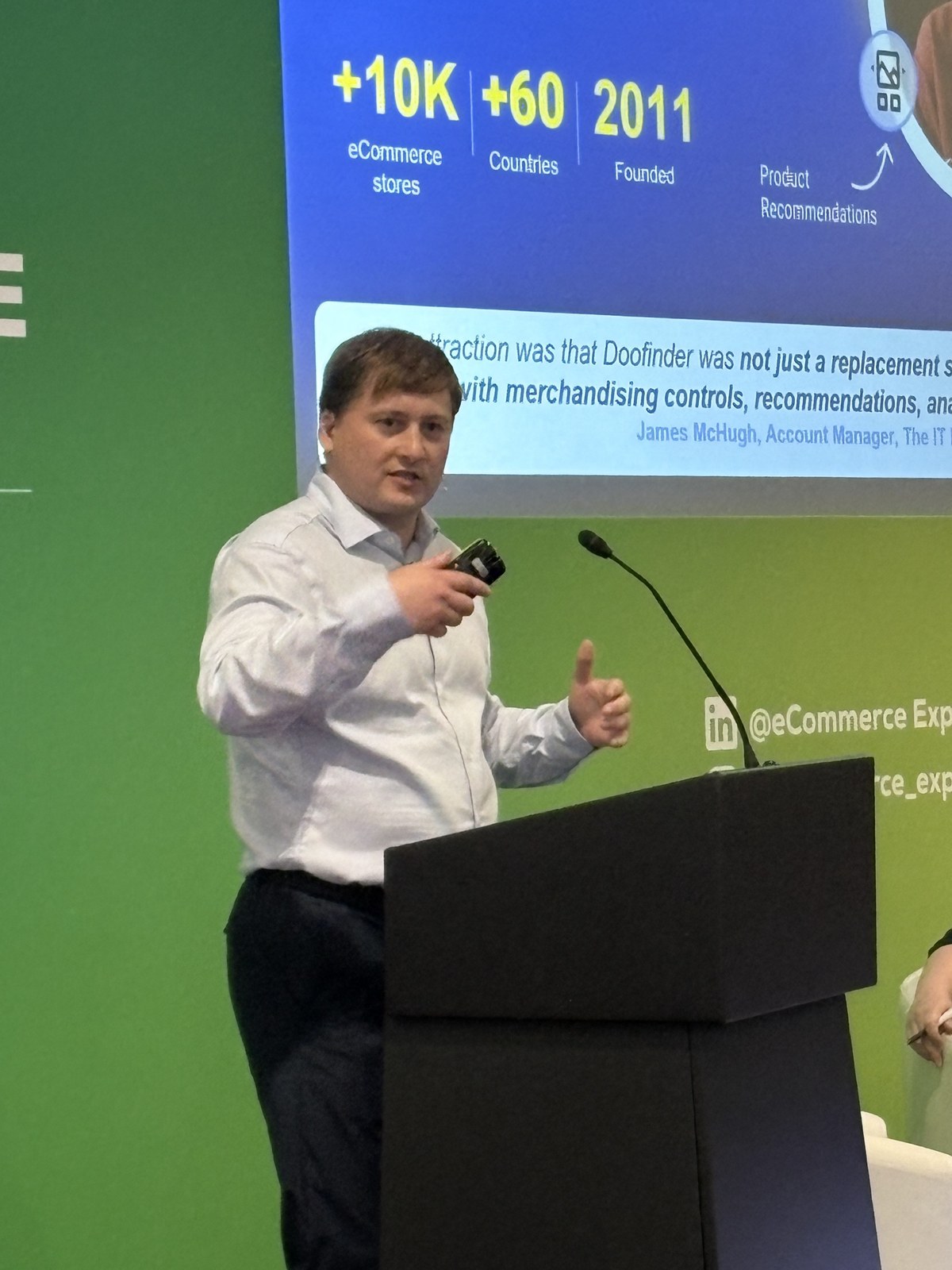
I spoke on the Future of Digital Commerce Stage at Ecommerce Expo in London on 23 September 2026, on how AI has changed what on-site search has to do.
Why Now
Three numbers set up the whole session. There are 50.2 million monthly shopping-intent visits to ChatGPT in the UK. Forty-six per cent of UK shoppers have already used AI tools while shopping online. And 35% of UK retailers are investing in AI to support sales and marketing.
Shoppers have changed how they ask for things. Most on-site search has not changed with them.
The Problem I Started With
Most of our clients run large catalogues with product data arriving from different suppliers in different feeds. The usual advice is to get all that data onto the website. Which is right, and which creates the next problem.
The more attributes and values you hold, the harder the site becomes for a human to keep usable. On The IT Bay, an IT hardware retailer running Magento 2, the word laptop alone covers more than 4,000 products. Search a term that generic and you get thousands of loosely related results nobody is going to scroll.
The default search on every platform I work with, Magento and Shopify included, is simply not built well enough for that.
Search Behaviour Has Already Changed
Here is the part most merchants have not caught up with. The way people type into ChatGPT has changed the way they search everywhere else, including on your own website.
It is no longer keyword search. It is intent search. Someone does not type laptop. They type, I am looking for a laptop for my office work. If your search cannot handle a sentence, it cannot handle how people now ask.
The numbers behind this are not dramatic but they are consistent. General conversion sits around 2.7%. Sessions that involve search convert at roughly 4.6%. Search is already your best-converting traffic, which is exactly why it is worth fixing rather than tolerating.
What We Actually Did
We tested several platforms, not one. I want to be clear about that, because I am on a stage with my name attached and I would rather talk about something I am willing to defend.
What stood out was not the search box. It was category merchandising, product recommendations and the AI assistant sitting alongside it.
On the product detail page there is an ask-assistant button. When somebody lands there from Google Shopping, the assistant already knows the context, the product and its attributes, so the shopper can ask a question and get a human-sounding answer immediately instead of waiting for someone on your team to reply.
In practice it behaves like an extra support engineer running twenty-four hours a day, while the rest of the team are asleep. It will not replace a human. You still need someone answering the phone. It removes a lot of the repetitive traffic from your team.
The Results
On The IT Bay, search conversion went from 5.3% to 7.9%, peaking at 10.6% in July.
Forty-six per cent of total sales are now attributed to search. That is the number that changed how I think about it. Search stopped being a feature on the page and became part of how the business sells.
Weekly search-driven revenue is up 139%. Search click-through sits around 57%. On the assistant specifically, click-through is 34.6%, and 6.3% of interactions lead to a purchase.
Across seven implementations I have been involved with, in automotive, clothing, and beds and furniture, the average increase in conversion on search sessions is around 29%.
The Part Nobody Puts on a Slide
When I was comparing vendors, what struck me was how many of them try to sell you everything at once. The whole enterprise package, every module. That is not a product decision, it is a commission structure.
Being able to switch features on as you need them mattered more to me than any single feature did. So did support. I have them on WhatsApp. That is not the level of support you get from most enterprise software, and anyone who has waited three days for a ticket response knows exactly what I mean.
Where It Goes Next
The dashboard turned out to matter as much as the front end. You can see what people search for, and more usefully what returns nothing. Zero-result searches tell you what your catalogue is missing, which makes search a merchandising tool rather than a convenience for shoppers.
That is the real shift. Search used to be a purely consumer-facing feature on your website. It has become something that drives decisions in the business.

Ecommerce Expo ran from 22 to 24 September 2026 in London. Alongside the talk we exhibited on stand M62 and co-hosted two evening events for founders and operators.